


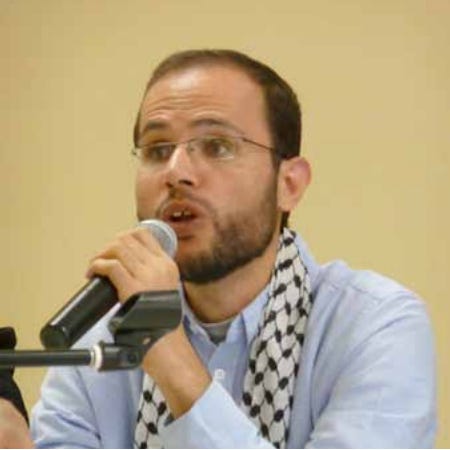
Refaat Alareer was born on 23 September 1979 in the Gaza Strip, in the neighborhood of Shujaiya. He was born and raised under occupation, which means that, as he said, “every move I took and every decision I made were influenced (usually negatively) by the Israeli occupation”.
He finished a BA in English language and literature from the Islamic University-Gaza in 2001, and a MA in Comparative Literature from University College London (UCL) in 2007. He is currently about to finish a PhD in English Literature at University Putra Malaysia (UPM).
Refaat lived in Gaza with his wife and 6 kids. He taught world literature and creative writing at the Islamic University-Gaza. As a kid, he said, “I grew up throwing stones at Israeli military Jeeps, flying kites, and reading”.
His final poem, If I Must Die, written just weeks before his killing by an Israeli airstrike in Gaza, echoed across borders and languages, giving voice to the grief and resistance of a people under siege.
Three years on, the genocide in Gaza is ongoing. Tens of thousands have been killed by the Israeli army. The latest aerial images of Palestine published on Google Maps show a wasteland of rubble where once were cities, homes, schools...
I had the honor to interview Refaat Alareer a few years ago, thanks to my work with Comma Press. I reproduce the interview here, as a tribute to this passionate educator and mentor. He was a co-founder of We Are Not Numbers, a platform amplifying young Palestinian voices.
Tell us a bit about yourself…
I am Refaat Alareer. I was born in 1979 in Gaza Strip, Shujaya. I was born and raised under occupation, which means every move I took and every decision I made were influenced (usually negatively) by the Israeli occupation. I finished my BA in English language and literature from the Islamic University-Gaza in 2001, and my MA in Comparative Literature from University College London (UCL) in 2007, and currently about to finish my PhD in English Literature at University Putra Malaysia (UPM). I live in Gaza with my wife and 6 kids. I teach world literature and creative writing at the Islamic University-Gaza. As a kid, I grew up throwing stones at Israeli military Jeeps, flying kites, and reading.
When did you begin writing? Tell us the first memory you have of you writing?
I started writing in English during Israel’s 2008 offensive on Gaza that left about 1400 Palestinians dead. I still remember how I felt obliged to write back in English to reach out to the world to educate people about Palestine and save them from the dominant Israeli multi-million dollar campaigns of misinformation. The first real piece was a short sarcastic piece imitating Jonathan Swift’s “A Modest Proposal” in which I suggested instead of murdering Palestinian kids, Israelis should eat them up for their nutritious values and at the same time rid themselves of the so-called Palestinain demographic threat. But later, my writing was ignited while I was teaching comparative literature and creative writing to my students. Social media such as blogging and twitter made writing a daily practice, albeit in the form of very laconic posts and tweets.
Were you a reader in your youth? What was your relation with books when you were a child? Were books available?
As a kid growing up in the first Intifada, books were a luxury we could not afford. We grew up attending wedding parties and listening to Palestinian folk songs and resistance songs. That was the major source of education on Palestine. Other sources of reading were Palestinian factions press releases and graffiti. When at night young masked Palestinians sprayed the walls with graffiti, we could not wait for the day to break so we go around and read again and again every single word of that. Reading these was an act of resistance. It was the least, we kids, could do, besides throwing stones at the military Jeeps.
Having books on Palestine and resistance was a crime punishable by the Israeli occupation. I remember my elder brother and I had an Intifada poetry book. I used to read it with the doors and the windows shut. I never told anyone we had that book at home. It was like I was hiding a bomb. If we had been caught with such materials or with a Palestinians flag or a poster of Yassir Arafat, we might have ended up spending 6 months in Israeli prisons, or, worse, our father’s work permit would have been suspended.
School books were ok, but they did not help us understand what was going on. In Gaza, we had to use Egypt’s school books. And all references to Palestine were censored and erased by the Israeli occupation authorities. Whole pages and paragraphs were blank. That was where Palestine existed.
Let’s talk about your own work.
I edited and contributed to “Gaza Writes Back”, a collection of short fiction written in English by 15 Young Palestinians living in Gaza. I also co-edited “Gaza Unsilenced”, which is a book of articles on Israel’s 2014 offensive on Gaza that killed about 2400 Palestinians. I also published a journal article entitled “Gaza Writes Back: Narrating Palestine”. I have a bunch of unpublished poems and other stories I am hoping to bring to the light soon.
Is there a distribution for your work both inside and outside of Palestine?
“Gaza Writes Back” is now in 7 languages. The book was published by Just World Books, a small, but influential, publisher in the United States. They do all the distribution to the English edition.
When I am done with my PhD, I am hoping I will invest more time and efforts into writing fiction and poetry. I have few unfinished texts that I am hoping to bring out to the world.
Which of your books/stories have been published in other languages?
“Gaza Writes Back” is in English, Italian, Turkish, Malay, Bengali, Persian, and (partly) Japanese. I had one of my poems translated (online) into Spanish.
https://thisisgaza.wordpress.com/2014/09/04/spanish-translation-of-my-poem-i-am-you-soy-vos/
What is your feeling on translation?
Translation is the best thing that happened to humanity. Translation breaks barriers and builds bridges and creates understanding. But “bad” translations could also create misunderstandings. And as much as I believe, and love, translation, I also believe that we need to train ourselves to express our concerns in the target language, here English. As Palestinians, there is good material that is translated into English and other languages, and there are people who speak for Palestinians in other languages. This is a two-fold weapon because we have always seen how mainstream media especially in the West mispresents Palestine by adopting the Israeli military discourse, terminology, and ideology. Translation here is dangerous and misleading.
Therefore, as an academic in an occupied land, major concern is to train as many people as possible to write effectively in English so that they express themselves in the way, discourse, and method they see fit, and hence overcome the dilemmas of translation.
In a word, we, Palestinians, need to translate Palestine. And Palestinians who are able to speak for themselves in other languages should to that directly.
Personally, I’d love to be part of a project to translate Palestinian folklore into English. This popular literature closer to the reality of Palestine and better represents the depth and richness of Palestinian culture and heritage.
Tell us a bit about your literary, musical, cinema influences...
In general, I love English poetry (my PhD is on John Donne’s poetry). I read Shakespeare. But I also love to read Russian, Italian, South American, and African Literature. I love reading literature by native peoples in America, Canada, Australia … etc. I have been influenced by Shakespeare, John Donne, Laurence Stern, Aphra Behn, George Eliot, T. S. Eliot, and Aphra Behn. I have some interest in Israeli and Hebrew literature and hope to develop this interest soon. Currently, my interest is mainly in emerging young artists and how they react to mainstream trends that try to silence them or render them irrelevant or immature.
I listen to classical Arabic music and resistance folklore especially Palestinian nasheed. I listen to some American country music.
I usually love a movie that was originally a book. I love movies with plot twists, or sub-plots. I also use them in my teaching. My Top movies include “Apocalypto”, “Death Sentence”, “First Blood”, “Room”, “No Country for Old Men”, “There Will Be Blood”, “The Magnificent Eight”, “Pulp Fiction”, “The Pianist”, “The Book Thief”, “The Slumdog Millionaire”, “Freedom Writers”, “Great Debaters”, “In the Valley of Elah”, and “The Reader”.
How do you write? Does a story come to you, or a character comes first? What are the themes, issues, concern you address in your books?
Whether it is fiction, poetry, or articles, I always seek a spark. In literary writing, once I have the “revelation” or the spark of a certain story or a poem, it either pours itself onto the page or takes me ages to finish. I have written texts in a couple of hours. And at the same time, I still have a poem that I have been working on for more than 4 years. In fiction, I always feel that once I think of an event or an encounter or a bit of dialogue, the characters evolve accordingly and take the lead and free themselves from me as the writer.
If I am writing an article, the timing is important or else the topic loses its thunder. During Israel’s 2014 massacres, one of my articles had thousands of shares. It came soon after Israel bombed the Islamic University where I work and obliterated the offices of the Faculty of Arts. The article was entitled “There are no Poems of mass Destruction”. The article was timely, I brought my experience of teaching Jewish characters to Palestinian students in the piece. But I think the fact that the piece was cooking in my mind and heart for about 2 years helped it mature and reach out to greater audiences.
I classify what I write as resistance writing, as writing back, not that all I do is reacting to the political situations. In Palestine, everything has become political. Poetry is political. Fiction is political. Photography is political. Teaching is political. Living is political. But when I do write or when I teach my students to write, I urge them to transcend the particularities into the universal. I believe one reason “Gaza Writes Back” is a success is that it turned very personal Palestinian stories and voices into timeless and universal fiction that appeals to all regardless of age, race, ideology, ethnicity, or religion.
How important is language for you in your work?
Words. Words. Words. As Hamlet says. Language is all we have to voice our struggle and to fight back. The words are our most valuable treasure that we ought to utilise in order to educate ourselves and educate others. And these words ought to be conveyed in as many languages as possible. And no matter what, I believe in a language that touches the hearts and minds of as many people as possible.
Do you feel you are part of a generation?
I do. And I am hoping that I am leaving something worthy behind. In the coming years, I will work very hard to provoke as many stories and poems from Young Palestinians as possible. The problem is that for many Palestinians living under Israeli occupation, with the political division, add to the brutal Israeli siege on Gaza where people cannot travel and sometimes get no more than 3 hours of electricity per day, writing is a luxury that most do not and cannot afford.
The contributors to “Gaza Writes Back” have been described as future Ghassan Kanafanis. This could be an overstatement, but this is where great writers, thinkers, intellectuals, freedom fighters, and human rights defenders come from. And my job as an academic and activist is to make sure to equip these young people with the skills they require.
We are the generation that took the brunt of Israel’s aggressiveness and managed to fight back with all the means available. Online, this generation managed to beat Israel’s error-riddled narrative. This generation managed to reached out, using social media, to every corner of the world and expose Israel’s crimes and human rights violations. Palestinians’ call for BDS (Boycott, Divestment, Sanctions), for example, is gaining momentum as a creative non-violence means of resisting Israel’s occupation, and obliging Israel to give Palestinians their rights.
I do my best to contribute positively to this generation and its steadfastness in the face of man-made crises that seem to never end because Israel wants to punish us Palestinians for not having the Jewish genes.
How would you consider the Palestinian literary scene at the moment?
The Palestinian literary scene is, in my honest opinion, in disarray. The literary scene in Palestine has two major flaws: the chasm between the old and the young and the domination of non-Palestinian voices. Usually established writers who have done a great job for the Palestinian cause tend to look down upon emerging writers. Rarely do I see an event or a project where old and young people work together or where the established writers work with the young ones who really need the support and guidance of experienced writers. This gap has existed everywhere and it negatively influences the young writers. However, a silver lining here is that the young writers develop their own independent usually revolutionary identity that is more daring more unconventional.
Secondly, if you look at major pro-Palestine events, sometime they are dominated by pro-Palestinians voices. While they are significant and needed, these voices usually occupy the space that should be dedicated to Palestinian voices. In other words, while all sorts of support are welcome, it is Palestinians who have suffered 7 decades of occupation, terror, humiliation, dispossession, and injustices. Palestinians are more capable of conveying their message and concerns to the world. When Palestinian voices are muted or sidelined, we jeopardise the whole cause and doom Palestinian voices to oblivion. That is Palestinians should represent themselves; they should not be represented.
Therefore, more should be done to nurture emerging Palestinians voices, translate and showcase them, and present them to the world. The least to be done here is to constantly hold events for young Palestinians only, to publish their works, to fund their reading clubs and events, and to sponsor and encourage literary contests. These events can bring together Palestinians from Gaza, the West Bank, Jerusalem, areas occupied by Israel in 1948, and the Diaspora in one platform, where books and other forms of literary productions can be nurtured. This is how we can unify Palestine and create a Palestine that Israel and its allies are working very hard to prevent from existing.
Do you feel there is a policy of supporting culture? I mean, for example, at local level, in Gaza, is there any institutional support for culture, literature, libraries etc
I do not think there is an official strategy with strategic plans to support Palestinian culture. However, there are some individual initiatives or ones organised by activists. And these are not enough. Due to the lack of the needed support, many talents die out and give up on pursuing their hobbies in producing good literature. Maybe the general situation is partly to blame, but there is no excuse whatsoever that can prevent us from taking care of our own culture and heritage because this is what we will be living behind for the generations to come.
What does literature mean to you?
Literature especially fiction is timeless and universal, and that is a fact. In my classes, we read fiction from all over the world across time and place and we still identify with the characters and feel sorry for their pains and happy for their gains regardless of their race, skin colour, ideology, or ethnicity. Reading literature and stories like the ones in Gaza Writes Back takes us to the homes, minds, and hearts of people from all over the world. Reading these stories helps people transcend the barriers of language, ideology and geography and brings us closer. A book like Gaza Writes Back is a reminder to people of all faiths that we are all human and that these little children exposed to the brutality of Israeli occupation could be us, could be our own children or nephews and nieces.
Still, literature has the ability to educate us, to heal us, to bring us all together, and to open up new possibilities of a better future. Literature has the ability to create bridges and reach out to all. That is why people who read and appreciate literature tend to be more thoughtful. And that is why totalitarian regimes hate literature. In the oppressed societies, literature is usually connected with their struggle and fight for human rights and justice. Literature becomes and is resistance. It is not strange then that Israel targets Palestinian intellectuals, novelists, and poets. Nowadays, Israel, for example is persecuting Palestinian poet Nadeen Tatour, whose only crime was to express herself in poetry. And it is reported that Israeli general Moshe Dayan likened reading Fadwa Tuqan’s poems to facing 20 commandos.
And connected to the previous question, we live in a world where the idea of “the other”, different from us is used to create fear of the other. How can literature help to defeat this fear? Break barriers and borders, walls?
Literature brings all together in one space, regardless of race, religion, skin colour, or ideology. Usually when we read literature we strip ourselves of our prejudice. Good writers usually help their readers identify with certain characters and bring us closer to their pain and plight. When start asking ourselves “what if we were in their shoes?”, truth about the fact that we are humans dawn on us and thus shatter prejudice.
A story about a small Palestinian kid’s last moments as he bleeds to death following an Israeli missile that targeted a group of kids playing football is usually an invitation to imagine ourselves or our loved ones in this situation. Good readers usually react responsibly, change their behaviours, attitudes, or even ideology. As Palestinians we’re counting on literature to break all barriers and walls built by the Israeli occupation and its misinformation campaigns to give voice to the voiceless and face to the faceless and take Palestine to the homes, lives, hearts, and minds of people all over the world.
Because literature liberates us from our prejudices and ideologies, it is an important tool of education and enlightenment. That is why we hope and have to work harder so that Palestinian literature reaches out to all, including Israeli occupiers. Who knows, maybe one day they will realise the absurdity and brutality of their occupation.
However, literature is a double-edged sword because it can also be used as a propaganda tool. This is true of much of Jewish literature in the end of the 19th century and the 20th century. For the Zionist movement, literature was used as a tool to convince the Jews of the world to go to Palestine. To do so, among many other unethical things, the Zionists presented Palestine as empty, as a land without a people, awaiting the so-called “rightful” people to go and enjoy its milk and honey. In much of Israeli literature, Palestinians are misrepresented and excluded. They do not have a voice or a face. And if they do, they’re mostly terrorists or backward.
Again, insisting on the discussion about the writer (and intellectual) role and involvement with what goes around him/her, in a recent interview Syrian writer Khaled Khalifa was saying: “I have always wondered about the ability of some writers to remain silent while the body parts of their own people are strewn about: murdered or drowned, refugees or prisoners; when a regime destroys a country and kills civilians, with impunity and for its own survival. This silence is disgrace itself, and it will follow those writers as much as those who justify crimes in any name whatsoever”. Letting aside the personal view on Syria, do you agree that writers shouldn’t remain silence while war is almost everywhere.
Silence is betrayal. Silence of intellectuals and writers is complicity. It is said that the pen is mightier than the sword. And at times of war or great oppression and injustices like what’s happening in occupied Palestine, Syria, Yemen, Iraq,…etc. real intellectuals are texted. If they side with the tyrant or dictators and not with the oppressed, they become oppressors themselves simply because their words justify oppression or whitewash it.
It is often said that solving the Palestinian question would actually give the Middle East a new perspective. Can you tell us how is the situation in Palestine at present? We read news of a prisoners hunger strike (it was called off after some 40 days, as Israeli authorities apparently have accepted prisoners’ requests) and of yet another possible attack on Gaza. [2017]
Israel is an occupation that depends in its existence on the destruction of the others, their heritage, their lives, their future, their land, and their livelihoods. In 7 decades of occupation, Israel uprooted over a million Palestinian olive trees and over a million Palestinians were imprisoned including thousands of kids and women, many without charge or trial. Israel steals almost all Palestinian natural resources including water and prevents Palestinians from using any of these resources. Israel is literally turning the West Bank into a Swiss cheese with small pockets of Palestinian areas surrounded by Jewish only roads or settlements. Palestinians cannot build on their own land and if they do Israel will demolish the homes and villages. Israel has long turned Gaza into the largest open air prison in the world. These medieval practices reflect Israel’s disregard to non-Jewish lives and its insistence to destroy Palestine, her people, and any chance of independence or self-determination.
There are currently about 6 thousand Palestinians in Israeli prisons including many children, women, journalists, and lawmakers. Scores are kept without even a charge or trial. Gaza is currently living its worst of days. Borders are closed by Israel; very few people are allowed or out and Israel allows the bare minimum of imports and exports. Students can’t join their universities outside Gaza, sick people die waiting for Israel to approve their permit for medical treatment.
Two million people in Gaza live with about 3 hours of electricity, and you can only imagine how horrible this is. Thanks to Israel, there is about 45% unemployment in Gaza. Over 90% of Gaza’s water is unfit for human consumption. The UN declared Gaza unfit for life by 2020.
In a word, what is happening in Palestine and especially in Gaza and areas like Jerusalem is a slow genocide. Israel want us all dead, or gone forever or living in fear and chasing crumps of bread 247. Gaza is suffocating in the worst sense of the word. What is going on in Gaza now is a slow death or a systematic process to drive Gazans towards insanity and despair.
Rafah Crossing has been closed for nearly 120 days now. It means ill people die awaiting medical treatment. It means students can’t join their universities. It means businessmen can’t do their work. With most civil employees getting about 50% to 70% of their salaries, it means a lot less money gets into Gazans’ pockets. That means less food on the table. It means young people do not go to universities. It means people struggle to provide for their families.
Let’s talk about the initiative Gaza Writes Back. When did you start this, who is involved, what are the campaigns it runs?
The idea to compile a book of stories came to me during Israel’s 2008 attacks against Gaza that lasted 23 days. I spent these days telling my kids stories to distract them from the explosions and the gunpowder that was suffocating us. These stories sparked a passion for storytelling and took me back to my mother’s and grandmother’s stories. They made me realise I, as a person, am the sum of these stories. When I went back to my classes, I started assigning my students to write short fiction instead of research papers. I held several training courses in short story writing and creative writing. The result was amazing. I picked 23 stories from more than 100 pieces I collected. We wanted the 23 stories to counter Israel’s 23 days of terror.
Gaza Writes Back is first and foremost a book of literature, a book that came for the same reasons why all literature is written, and artistic activities are as old as human life. They signify willingness, usually daring, to resist the repetitiveness and dullness and dreariness of life. Literature defies all acts of suppression and oppression because oppressors are always dull and repetitive, while makers of art are creative and innovative. Literature stands out as a testimony for the generations to come. But literature is too a powerful means of self-expression and a sharp reflection on the world we live in, be it oppressive, repressive or even completely falling apart.
The short fiction pieces in Gaza Writes Back were compiled to become a testament of the importance of one’s determination to live and resist occupation and oppression for the future Palestinians just like we now read Ghassan Kanafani more than history books. Moreover, writing a book like Gaza Writes Back is part of our duty and moral obligation as young Palestinians to reach out to the whole world to educate them, and thus us, about our plight under the racist Zionist occupation.
Gaza Writes Back humanizes the Palestinian plight and universalizes it. It gives voice to the voiceless and a face and a name to the faceless at a time when the all-powerful Israeli narrative is distorting all facts and figures. And the book, I believe, generated more books and literature in Palestine.
More young Palestinian writers are now more willing to write and express themselves openly, because they have seen how a short story or a book can make a huge difference. Several young Palestinians have approached me and asked me for advice or feedback on their pieces. In my classes at the Islamic University, Gaza, I am witnessing a surge in the number of students who want to write, especially fiction. And I also know that many are now working to document the last war in the form of stories similar to those in Gaza Writes Back.
Gaza Writes Back was published in the United States and sold globally, in addition to being translated into Italian, Turkish, Bengali, Malay, Persian, and Japanese. People from all over the world, including South Africa, South America, Australia, New Zealand, Canada, England, France, Egypt and Saudi Arabia, have been contacting me for either interviews or a permission to teach part of my book in their classes. The feedback we receive is amazing. And we have witnessed first-hand during our book tour in the United States show just how significant a book like Gaza Writes Back is in educating people and raising awareness.
Several people have contacted me asking to work on “Gaza Writes Back” for the MA’s and PhD’s. We hope the book can be translated into more languages such as German, French, Spanish and Portuguese and Arabic.
Originally published in Global Rights Magazine